
Why Your Cannabis Tissue Culture Lab Is Failing: A Diagnostic Guide
Most underperforming cannabis tissue culture labs are not failing for many reasons at once; they are showing several symptoms of a small number of root causes in sterile technique, media, workflow, or training, and the symptoms are specific enough to tell those causes apart.
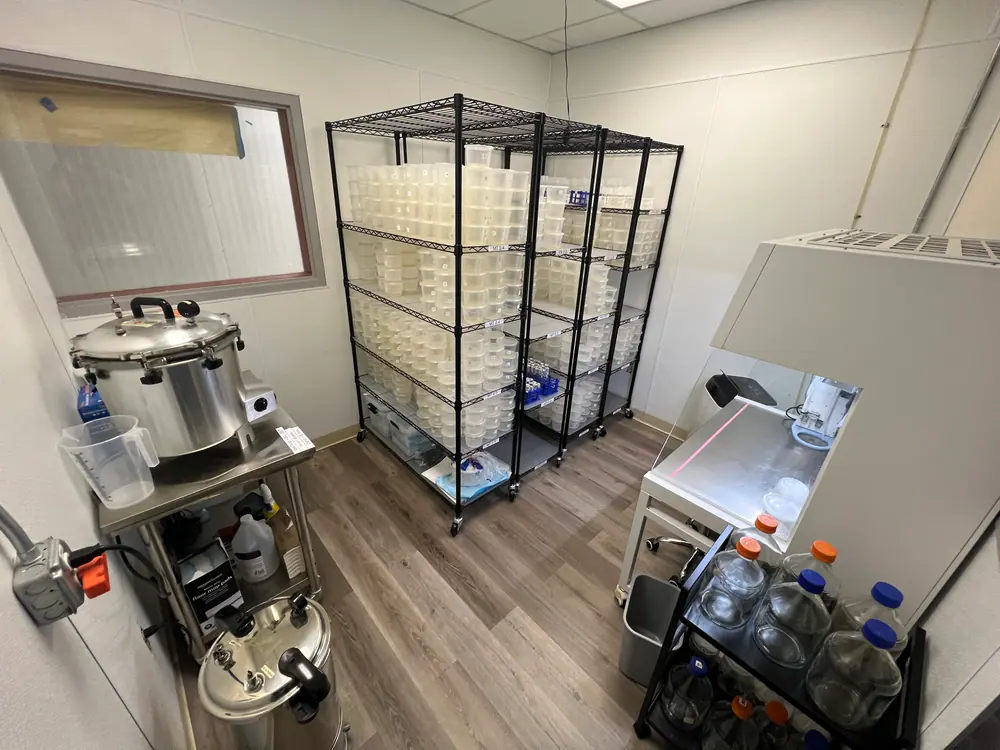
A lab that is not working rarely has one problem. It has one root cause producing four symptoms, and a team treating all four separately.
The good news is that tissue culture symptoms are specific. Browning is not contamination. Bacterial contamination that appears on day two is a different problem from bacterial contamination that appears on transfer four. If you read the symptom precisely, it usually tells you where to look.
This is the diagnostic order we work through when auditing a lab that has stopped producing.
Start with the records, not the cultures
Before looking at a single vessel: can you answer, from written records, which media batch a failing culture came from, who did the transfer, and what the contamination rate was in that stage last month?
If you cannot, that is the first finding. Not because paperwork is virtuous, but because every diagnosis below depends on comparison. A contamination rate means nothing without last month’s rate. A bad batch is invisible unless you can see which cultures came from it. Labs that cannot answer those questions are not troubleshooting, they are guessing, and they usually end up changing several things at once and learning nothing.
Fix the record keeping first or you will do this again in six months.
Contamination that will not clear
The timing tells you the type, and the type tells you the cause.
Appears within 2 to 4 days, fuzzy, spreading across the media surface. That is usually airborne fungal or a technique breach. Look at hood work: hands moving over open vessels, tools not flamed between cuts, vessels open too long, traffic past the hood, or a HEPA filter overdue. This is the most common contamination in a young lab and it is a training problem far more often than an equipment problem.
Appears within 24 to 48 hours, cloudy or slimy, often at the base of the explant. That is usually bacterial from the source material or from an inadequate surface sterilization step. Check the sterilization protocol and contact time on incoming material.
Appears on transfer three, four, or later, in cultures that looked perfect for weeks. This is the one that fools people, and it is the one that makes a lab feel cursed. That pattern points to endophytic bacteria: organisms living inside the plant tissue itself, which surface sterilization cannot reach because they were never on the surface. They multiply quietly and only become visible once the population is large enough. If your contamination shows up late and follows specific cultivars rather than specific technicians or specific days, stop auditing your hood technique and start looking at the source material and the lines it came from.
That distinction matters commercially. Technique contamination is fixable with retraining in weeks. Endophytic contamination in a line usually means re-initiating that line clean, and sometimes going to meristem to get ahead of it.
Browning
Browning is not infection. It is oxidation: the tissue releases phenolic compounds when wounded, they oxidize, and the tissue poisons itself. Cannabis is prone to it.
What actually drives it:
- Cut quality. Crushed or torn tissue releases far more phenolics than a clean cut. Dull tools and hurried work show up here first.
- Time between cut and media. Explants sitting exposed while the tech does five more oxidize before they ever land.
- Source plant stress. Material taken from a plant under nutrient or pathogen stress browns more.
- Media and transfer interval. Cultures left too long on exhausted media brown at the base.
If browning is concentrated in one technician’s work, it is technique. If it is across the board and worst on initiation, look at your source material and how far it travels before it hits media.
Multiplication rates that keep dropping
A mult rate that declines over cycles is usually one of three things.
Media exhaustion or interval drift. Cultures held past the point where the media supports them stall, and the next cycle starts weaker. If your subculture interval has quietly stretched because the team is behind, the rate drop is a scheduling problem wearing a biology costume.
Hormone balance drifting out of range for that cultivar. Cannabis cultivars do not all respond the same way to the same recipe. A media formulation that works beautifully on three cultivars can underperform on a fourth, and if you are running one recipe across the library you will not see it, you will just see an average.
Accumulated stress in the line. Populations carried a long time without a reset lose vigor. This is where a clean re-initiation, or meristem work if there is also pathogen pressure, resets the baseline rather than managing decline.
The way to tell them apart is per-cultivar and per-recipe data. If you only have a lab-wide average, every cause looks identical.
Cultures that will not root
Rooting failure usually traces back upstream rather than to the rooting step itself.
Carryover cytokinin from a long multiplication phase suppresses root initiation, so shoots that spent too many cycles in mult often resist rooting no matter what you do at the RIM stage. Undersized or low-vigor shoots going into rooting will also fail at a high rate, because they did not have the reserves to begin with.
If rooting percentages are poor across cultivars, look at what the shoots looked like going in, not at the rooting protocol.
Glassy, water-soaked, brittle growth
Hyperhydricity, often called vitrification. The tissue looks swollen and translucent and does not survive transfer well.
Usual drivers are excessive humidity inside the vessel, cytokinin levels too high, and gelling agent concentration too low. It tends to arrive in clusters, so if it appeared suddenly across a batch, look at what changed in the media prep or the vessel closure rather than at the cultivars.
HLVd showing up in lines you thought were clean
Two possibilities, and they need different responses.
Either the line was never verified clean in the first place, meaning someone assumed rather than tested, or it was clean and got reinfected through mechanical transmission during handling.
The way to know is dated records. If you have a negative qPCR result for that line with the report attached, and a positive one later, you have a containment problem in the lab and tool sterilization between cuts is the first thing to examine. If you have no prior result, you never had a clean line, you had an untested one.
This is why clean means confirmed clean rather than assumed clean. Without a dated history behind the claim, you cannot tell a containment failure from a bookkeeping failure, and those have completely different fixes.
Technique, training, or design
Almost every finding above resolves to one of three levels, and it is worth naming which:
Technique is an individual doing a step incorrectly. Fixed by retraining that person, quickly.
Training is nobody having been taught why the step matters, so the whole team drifts the same direction. Fixed by written SOPs and retraining against them. This is the most common one, and it is not a hiring problem.
Design is the room or workflow making the correct behavior hard: traffic past the hood, media prep sharing space with transfers, no logical clean-to-dirty flow. Fixed by changing the layout, and no amount of discipline compensates for it.
Most labs we audit assume they have a design problem and buy equipment. Most of them have a training problem and needed SOPs.
When to rebuild instead
Rarely. Most underperforming labs do not need to be torn out. They need the actual failure point found and fixed, in the workflow, the media, the sterile technique, or the training.
The honest exceptions are a room that physically cannot be kept clean, and a library where enough lines are compromised that rebuilding clean stock is the real project regardless of the room.
If you are firefighting instead of producing, we audit labs and tell you straight which of these you have before anyone spends on a rebuild.
Related reading: preventing contamination with clean-room SOPs, how to know if your clones have HLVd, and why meristem culture is the only real fix for HLVd.