
What Cannabis Tissue Culture Lab Software Actually Needs to Do
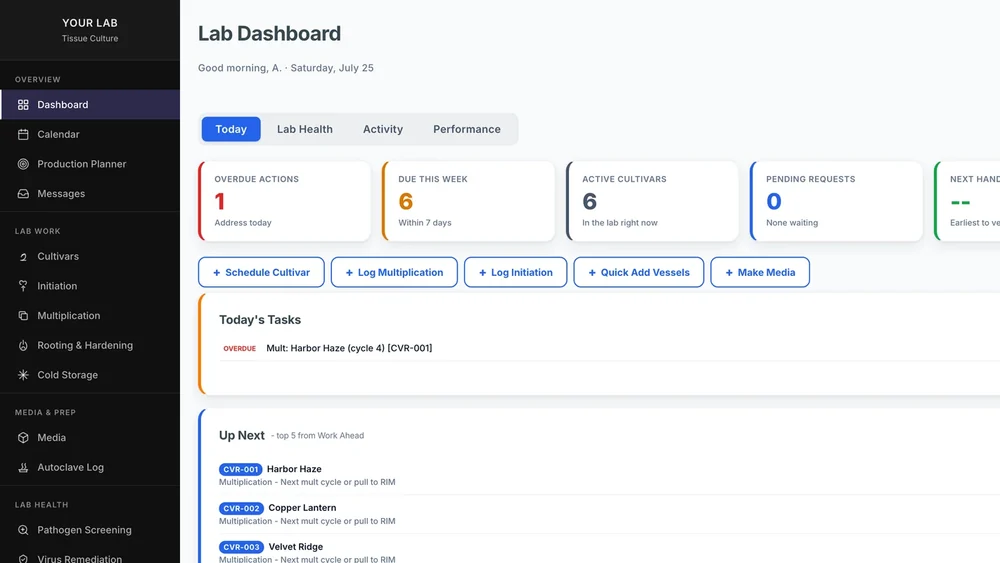
Cannabis tissue culture lab software is a system that tracks cultivars, cultures, media, and pathogen status through every tissue culture stage, and it differs from a generic LIMS because it has to model the biology of a living, dividing population rather than a fixed set of samples.
Every tissue culture lab starts on a spreadsheet, and that is the right call. When you are running six cultivars you do not need software, you need to get the technique right.
The spreadsheet stops working at a predictable point, and it does not fail loudly. It fails by quietly costing you an hour a day, then two, until someone is doing data entry instead of bench work and nobody can say when that started.
This is what to look for when you get there.
When the spreadsheet actually breaks
It is not about cultivar count on its own. It is about the number of things that have to stay in sync.
A single multiplication is one event with six consequences. The batch record. The next cut date. The elongated shoots that roll into rooting. The media you just consumed. The multiplication rate that feeds your planning. The labels for the vessels you just filled. On a spreadsheet, a tech updates one of those and the other five drift, or they update all six by hand and you are paying bench wages for typing.
Add a second technician and the drift compounds, because now two people hold different mental models of where things stand. Add a third cultivar line under the same cultivar, say a nodal population and a meristem population, and most spreadsheets quietly merge them, which means your counts are wrong in a way nobody will catch for a cycle.
The tell is not that you have outgrown the spreadsheet. The tell is that you have started to distrust it.
Why a generic LIMS is the wrong shape
The instinct is to reach for a laboratory information management system, because that is the category name. It is usually a poor fit, and the reason is structural rather than a matter of features.
A LIMS is built for a sample: a fixed thing that arrives, gets tested, produces a result, and is disposed of. Chain of custody, test queue, result, report.
Tissue culture does not have samples. It has populations, and they divide. One vessel becomes five. Those five carry the identity, the lineage, and the pathogen status of the parent, and then they divide again. What you need tracked is not “what was the result for this sample” but “what is this population, where did it come from, how fast is it multiplying, and is the line still clean.”
Seed to sale software is a worse fit again. It is built for regulatory compliance on plants that already exist as countable inventory. It has no concept of an explant, a subculture cycle, or a meristem line.
Neither is a bad product. They are answering a different question.
What it actually has to understand
Here is the honest list, drawn from running this work rather than from a feature comparison.
Cultivar identity, including split lines. A cultivar is one source, and it can carry more than one population underneath it. A nodal line and a meristem line of the same cultivar are not the same material and must not be counted as one number. If the software cannot hold that distinction, your clean-stock program is invisible to it.
Stage flow, end to end. Initiation, multiplication, rooting, hardening, cold storage, as one connected chain rather than six separate logs. The next cut date and the next handoff should be projected from what you logged, not typed in again.
Pathogen status carried per line, with history. Not a checkbox that says clean. A dated record of qPCR results, with the lab report attached, tied to the specific line it belongs to. Clean stock is a claim, and a claim needs evidence behind it that you can go back to a year later.
Multiplication performance from your own runs. Mult rate and elongation rate by cultivar and by recipe. This is the number that turns planning from guesswork into arithmetic, and it has to come from your logged cycles rather than from a default someone picked.
Media and batch traceability. Every batch with an ID, and every culture linked to the batch it went into. When one media batch goes bad, the question “which cultures did that touch” should take one click, not an afternoon with a notebook.
Contamination as data, not an incident report. Logged with the stage, the operator, the media batch, and a photo, so you can see a rate climbing in one recipe or one stage before it becomes a pattern you notice too late.
Planning that runs backward from the grow. The lab does not run on its own calendar. It runs on the flip schedule. Software that cannot work backward from the day the grow needs rooted shoots is making you do the hardest part by hand.
Labels that match the vessels. Unglamorous and constant. One sticker per cultivar and media, batch accurate, printed from the record rather than retyped.
Questions worth asking any vendor
If you are evaluating something, these separate the purpose built from the adapted:
- Can it hold a nodal and a meristem line under one cultivar and count them separately?
- Can it show me every culture that came from a specific media batch?
- Where does its multiplication rate come from, my data or a default?
- Can it work backward from a flip date to tell me what the lab has to do today?
- Can my grower see their own cultivars without seeing anyone else’s data?
- Who wrote it, and have they run a lab?
That last one is not a trick question. Most lab software is written by software people who interviewed lab people. It shows up in the small places, like whether the app understands that a multi recipe cut is one event that produces several records rather than several separate events.
Where ours came from
We built our cannabis tissue culture lab software because we kept setting up labs and then watching good teams manage them on spreadsheets that could not keep up.
It runs in the labs we build, including District Cannabis, and it is used by working technicians during production rather than demonstrated in a meeting. That is the only reason it handles things like split lineage and multi recipe cuts correctly, because those were real problems that broke the first version.
It is available as part of a lab build, or on its own for a lab you already run.
The honest answer
If you are running a handful of cultivars with one technician, stay on the spreadsheet. Software will not fix technique, and buying it early is a distraction from the thing that actually determines whether your program works.
When you can no longer answer “how many clean shoots of this cultivar do I have right now” without opening three files and doing arithmetic, that is the signal. Not before.
Related reading: tissue culture versus mother rooms, what it costs to build an in-house lab, and why meristem culture is the only real fix for HLVd.
If you want to see what your lab looks like on one connected system, book a walkthrough and bring your production schedule.