
How Much Does It Cost to Build an In-House Cannabis Tissue Culture Lab?
The cost to build an in-house cannabis tissue culture lab is driven by four things: the space and clean-room buildout, the equipment inside it, the ongoing cost of running it, and the size you scale it to, so the honest answer is that it depends on how much lab you actually need.
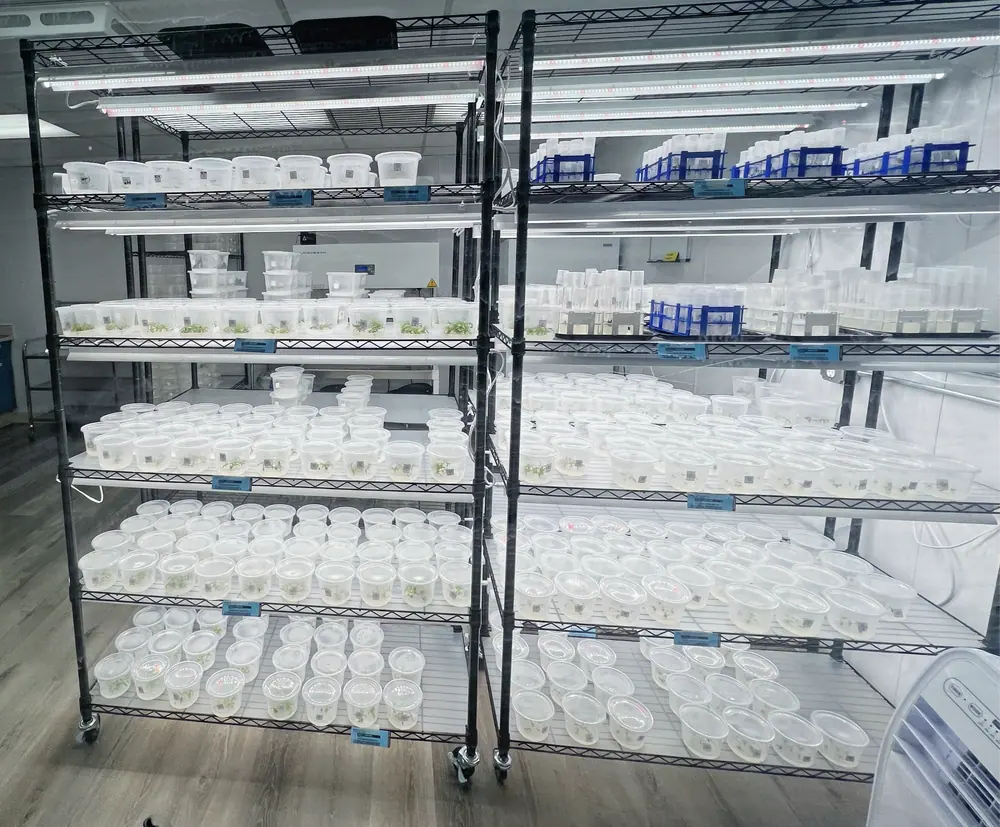
Every cultivator who calls me wants one number. I get it. But a lab is not a product you buy off a shelf, it is a system you size to your operation. The good news is the cost breaks into four clear buckets, and once you see them you can build a budget that fits your reality instead of someone else’s brochure.
Let me walk you through how the money actually works, operator to operator.
What goes into the cost of an in-house cannabis tissue culture lab?
The cost of an in-house cannabis tissue culture lab comes from four buckets: the space and clean-room buildout, the equipment, the ongoing consumables and labor, and the scale you build for.
Think of it as one-time costs and recurring costs. The one-time costs are the room and the gear that go into it. The recurring costs are what it takes to keep clean material moving through that room month after month. Most people fixate on the equipment line and underestimate the buildout and the running costs, and that is where budgets go sideways. Get all four buckets on the table first, then you can make real decisions.
How much does the space and clean-room buildout cost?
The buildout is often the most underestimated line, because a tissue culture lab is not a room with a bench, it is a controlled environment built from dirty to clean.
What you are paying for is separation and air. You need physically separated zones, sealed non-porous surfaces, HEPA filtration into your transfer room, positive air pressure so unfiltered air cannot drift in, and dedicated power, plumbing, and clean water. The single biggest cost driver here is your starting point. Converting a shell space with no HVAC and no clean water costs far more than adapting a room that already has good bones.
The mistake I see most is treating air handling as optional. It is not. If you cut the HVAC to save money on day one, you pay it back in lost material to contamination for years. I break the full zone-by-zone layout down in our guide to cannabis tissue culture lab design, and I would read that before you price a single wall.
What equipment do you pay for and which pieces drive the budget?
The equipment you pay for is the sterile-transfer, sterilization, and controlled-growth gear, and a handful of core pieces drive most of the budget.
Here is the core list in the order it usually matters:
- Laminar flow hood or cabinet, your single most important piece and the heart of clean work.
- Autoclave for sterilizing media, tools, and glassware.
- Controlled-environment growth space with proper photoperiod lighting, stable temperature, and humidity control.
- Media prep station with a balance, pH meter, hot plate or magnetic stirrer, and clean water source.
- Cold storage for holding clean material.
- Consumables to start: vessels, media components, gloves, and sterilization supplies.
The big-ticket drivers are the laminar flow, the autoclave, and the growth environment. Everything else is real but smaller. My advice is to spend for quality on the flow hood and the growth controls, because those two decide your contamination rate and your survival rate. That is where output is won or lost, so it is the last place to cut corners.
What are the ongoing costs of running a tissue culture lab?
The ongoing cost of running a tissue culture lab is mostly consumables, utilities, and trained labor, and it is recurring, not a one-time hit.
Consumables are the steady drip: media components, vessels, gloves, and sterilization supplies get used up every batch. Utilities matter more than people expect, because your growth room and air handling run constantly. And labor is the real one. A lab is only as good as the person at the hood, so trained hands are not a place to skimp. The reason this bucket gets missed is that it does not show up on the buildout invoice. Plan for it from day one so month three does not surprise you.
How does lab size and cultivar count change the number?
Lab size and cultivar count change the number more than almost anything else, because both drive how much space, gear, and labor you need.
More monthly output means more transfer capacity, more growth shelving, and more staff at the hood. Cultivar count works a little differently. Running many cultivars means more tracking, more separation, and more careful labeling to keep lines from crossing. It is less about raw square footage and more about discipline and systems. This is exactly why we pair every lab with the lab platform, so cultivar tracking, media recipes, and stage-by-stage records stay clean as you scale, instead of living in a spreadsheet that breaks the day you add your fortieth line.
What is the difference between a starter lab and a full production lab?
A starter lab is sized to prove the process and protect your genetics, while a full production lab is sized to feed your whole operation on a schedule.
Here is the honest comparison:
- Starter lab. Smaller footprint, one flow hood, modest growth space, one or two trained people. It preserves your best cultivars, produces clean Gen-0 material, and lets you learn the workflow with low risk. Lower upfront cost, lower running cost.
- Full production lab. Larger footprint, multiple transfer zones, redundant equipment, a real team, and the throughput to replace clones across your grow year-round. Higher upfront cost, higher running cost, and far more capacity.
You do not have to jump straight to the big build. Most operators are better served starting focused and scaling once the process is proven. We built a client lab in about six months that went live in early 2026, and it worked because we sized it to their actual production, not to an imaginary future.
How does building in-house compare to paying for outside clones over time?
Building in-house is a larger upfront investment, while buying clones looks cheaper per unit but carries recurring cost and risk that compound over time.
Outside clones come with vendor dependency, inconsistent genetics, supply-chain gaps, and disease risk, and HLVd is the one that keeps growers up at night. You often do not know material is infected until it is already spreading in flower. An in-house lab flips the model: you control your genetics, you know your material is clean because you produced it, and you stop paying someone else forever. I walk through when each path actually makes sense in in-house lab vs. buying clones. The short version is that established operations growing for years usually come out ahead building their own.
How do you budget for a lab without overspending on day one?
The way to budget without overspending is to size the lab to your real production, buy quality where it protects output, and leave room to grow.
Here is the sequence I take clients through:
- Start from your production target and your cultivar count, not from an equipment list.
- Assess your space honestly, because your starting point drives the buildout cost.
- Spend for quality on the flow hood and growth controls, and stay lean everywhere else.
- Design for expansion so you are not rebuilding in six months.
- Budget the recurring costs, consumables, utilities, and labor, alongside the buildout.
- Phase it. Prove the process in a starter footprint, then scale.
The most expensive lab is the one built wrong and rebuilt. Match the spend to the operation and you avoid that trap.
Let’s price your lab together
Every operation is different, and the right number for you comes from your genetics, your production targets, and your space, not a generic quote. That is the work we do. Take a look at how we design and build labs, and when you are ready, book a consultation and we will walk through your operation and build a budget that actually fits.