
Rooting and Hardening: Where Most Cannabis Tissue Culture Programs Actually Fail
Rooting and hardening are the two stages where cannabis tissue culture programs lose the most plants, but the cause is almost always a decision made earlier in multiplication rather than anything done in the rooting or acclimation room itself.
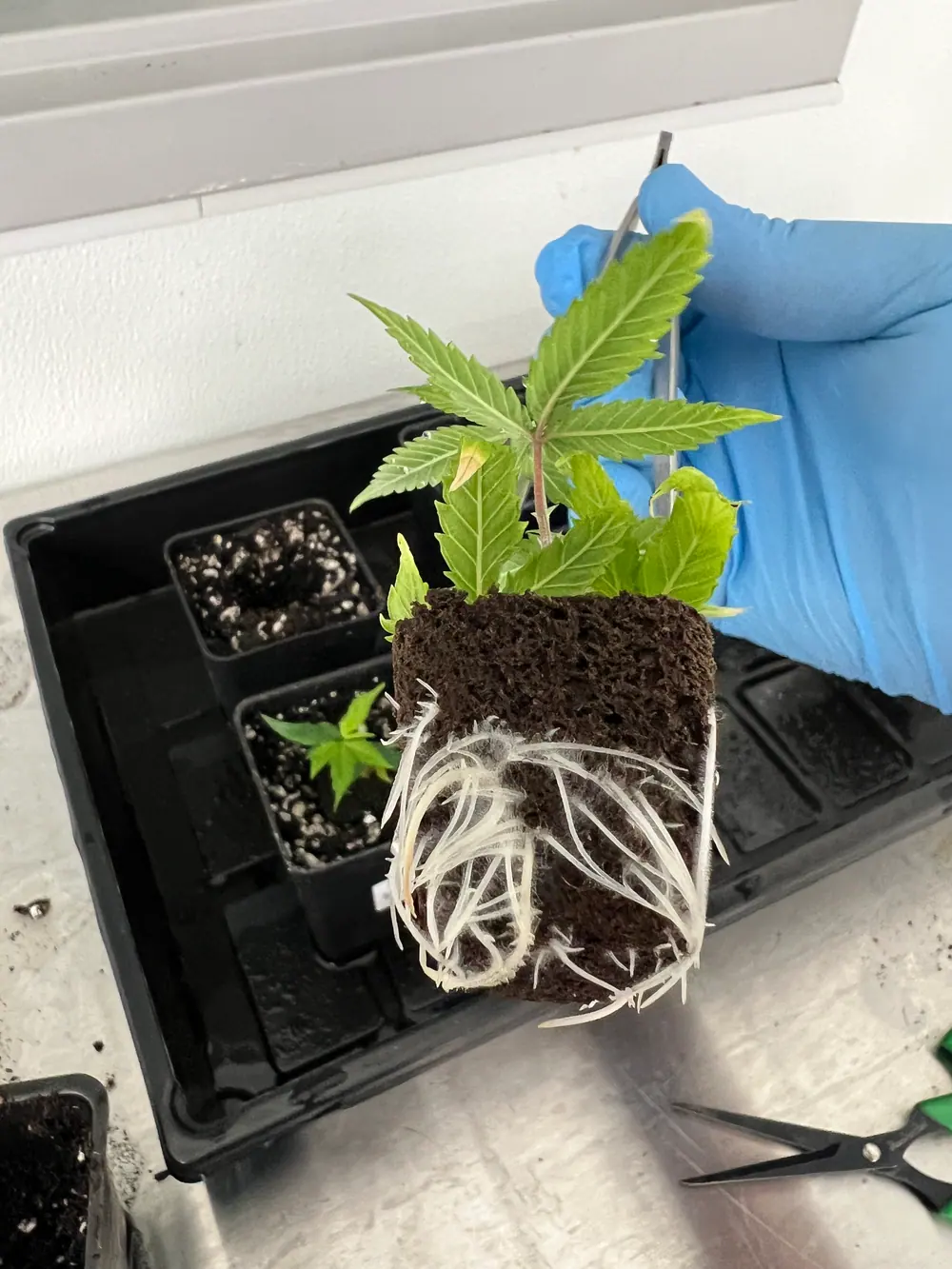
Ask an operator where their tissue culture program is losing plants and they will usually say rooting, or the acclimation tent. They are right about where the plants die. They are almost always wrong about why.
Rooting and hardening are the last two stages before a plant becomes a real clone in a real room, which makes them the stages where every earlier mistake finally becomes visible. A shoot that will not root is rarely a rooting problem. A tray that collapses in acclimation is rarely a humidity problem. Both are usually multiplication problems that took three weeks to show up.
This is the part of the process we spend the most time fixing in existing labs, and the part that most in-house programs underbuild.
What these two stages actually are
Rooting is the stage where a multiplied shoot is moved onto a rooting medium (we call ours RIM) and induced to form its own root system. In multiplication the plant is being pushed to make more shoots. In rooting it has to stop doing that and start doing something else entirely.
Hardening, also called acclimation, is the move out of the vessel and into the real world. A plantlet that has spent its life in a sealed container at high humidity, with sugar in its medium and almost no air movement, has a poorly developed cuticle and stomata that do not close properly. Put it straight into a normal propagation environment and it dries out in hours. Hardening is the controlled process of teaching it to be a plant that can survive outside a jar.
A working acclimation setup is not complicated: a humidity-controlled enclosure (a dome, a tent, or a chamber), gentle light, clean media plugs, and a written step-down schedule. What makes it work is that the schedule is followed and recorded, not that the equipment is expensive. Most labs we audit have adequate hardware here and no schedule.
Failure one: carryover cytokinin
Multiplication media relies on cytokinin to drive shoot proliferation. That is its job, and it does it well. But cytokinin also actively suppresses root initiation, and it does not vanish the moment you move a shoot to a rooting medium. It is still in the tissue.
A shoot taken straight off an aggressive multiplication cycle and dropped into RIM will often sit there: green, alive, not dying, not rooting. Weeks pass. The team concludes the rooting medium is wrong and starts changing it, which is the worst possible response, because the rooting medium was never the problem.
What actually fixes it is upstream. Cultures need a step down off high-cytokinin media before they are asked to root, whether that is an elongation pass, a lower-hormone cycle, or simply more time between the last aggressive transfer and the move to rooting. The details are cultivar-specific and belong in your SOPs.
The tell: shoots that are healthy and stalled rather than declining, across a whole batch, all of which came out of the same multiplication cycle.
Failure two: undersized shoots going into RIM
The second failure is more of a discipline problem than a biology problem. Multiplication produces a mix of shoot sizes. Under production pressure, the temptation is to push everything into rooting so the numbers look right.
Undersized shoots root poorly and slowly, and the ones that do root produce weak plantlets that then fail in hardening. So the loss does not show up in the rooting stage where the bad decision was made. It shows up a stage later, in acclimation, where it looks like an acclimation problem.
The fix is a minimum size and quality standard for entering rooting, written down, applied by whoever is doing the transfer, with undersized material going back for another multiplication cycle instead of forward. That is a hard rule to hold when someone is chasing a delivery date, which is exactly why it has to be written rather than remembered.
Watch also for hyperhydric (glassy, water-soaked, brittle) shoots. Those come from too much cytokinin and too little gas exchange in the vessel, they root badly, and they should not be advanced at all.
Failure three: the humidity step-down
This is the one failure on the list that really does originate in hardening.
Plants come out of the vessel needing near-saturated humidity, and they need to end up in ambient conditions. The mistake is at both ends. Step down too fast and you get wilting and death in the first 48 hours. Step down too slowly, or never, and you get soft plants that never develop a functional cuticle, sit there refusing to grow, and then collapse the moment they are moved to the grow.
The other common version is having no schedule at all: someone vents the dome when the plants “look ready.” That produces results that vary by who was on shift, which is exactly the kind of variance that makes a program impossible to forecast.
Treat the step-down as a protocol with defined stages and defined durations, log which tray is on which day, and adjust the protocol on evidence rather than adjusting each tray on instinct.
Failure four: the handoff to the grow
The last one is not a lab failure at all. A lab can produce a well-rooted, properly hardened plant and still lose it, because the receiving grow treats it like a rooted cutting.
It is not one. A freshly hardened plantlet is younger, smaller, and less stress-tolerant than the clones that team is used to handling, and it wants a gentler first week: lower light intensity, higher humidity than the standard veg room, and no feeding schedule designed for an established cutting.
This is a communication problem, and it is solved by the lab and the grow agreeing on handoff conditions in writing before the first tray moves, not by the lab producing better plants.
How to tell which one you have
| What you see | Where to look |
|---|---|
| Healthy shoots that sit in RIM for weeks without rooting | Carryover cytokinin, upstream in multiplication |
| Roots form, but plantlets are small and weak | Size standard entering rooting |
| Glassy, brittle, water-soaked shoots that root badly | Hyperhydricity: cytokinin and gas exchange in the vessel |
| Losses in the first 48 hours out of the vessel | Step-down too aggressive at the start |
| Plants survive but never take off, then fail on transplant | Step-down never completed |
| Plants look good leaving the lab and die in the grow | Handoff conditions, not the lab |
The pattern worth noticing: four of those six resolve to a decision made before the plant ever reached the rooting bench.
Why this stage gets underbuilt
Rooting and hardening are unglamorous. Initiation and meristem work are the techniques people are proud of, multiplication is where the numbers come from, and cold storage is the one that sounds like insurance. Rooting and hardening are the part that looks like ordinary propagation, so they get the least SOP attention, the least training time, and the least bench space in the layout.
Then they become the bottleneck, because they are the stage where the whole process is finally graded.
If your program is producing shoots but not delivering plants, the honest first step is to find out which of the six patterns above you actually have before changing anything. We audit and rehabilitate existing labs and that is usually the first thing we look at.
Related reading: why your tissue culture lab is failing, a diagnostic guide, Gen-0 clones vs traditional cloning, and cannabis tissue culture lab design and workflow.