
Indoor Growers' Secrets: 5 Tips for a Perfect Pre-Harvest Routine
A pre-harvest routine is the set of lighting, environmental, nutrient, watering, and defoliation adjustments indoor cannabis growers make in the final stretch of flowering to maximize crop quality, and its payoff is capped by the health of the genetics those plants came from.
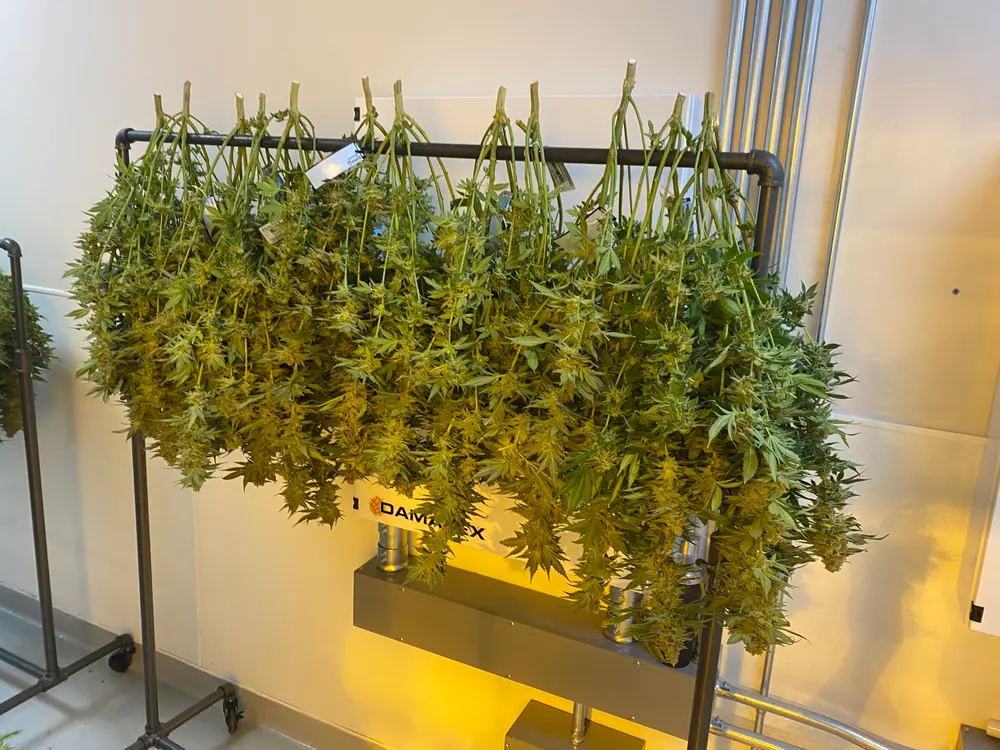
Harvesting is a crucial milestone in the journey from cultivation to consumption. Whether you are growing indoors, in a greenhouse, or outdoors, proper planning and pre-harvest preparation are essential for the best possible crop quality. Below are five adjustments that matter in the final stretch, and then the variable that decides how much any of them are worth.
1. Lighting adjustments
Indoor growers often make pre-harvest adjustments to their lighting setups. During the flowering phase, increasing light intensity by gradually moving the lights closer to the canopy can enhance cannabinoid and terpene production. Studies also indicate that introducing a few minutes of red-spectrum light per day may lead to increased yields and a richer cannabinoid profile.
2. Temperature and humidity management
As harvest approaches, lowering temperature and humidity helps prepare the plants for drying. Preserving terpenes and protecting against microbial contamination is vital for flower quality. Gradually reducing temperatures toward the end of flowering can also promote denser buds and tighter flowers, replicating the cooler temperatures of fall.
3. Nutrient adjustment
A well-timed reduction in nitrogen during the flowering cycle directs the plant’s energy toward bud and resin production. That means increasing phosphorus and potassium while reducing nitrogen. Take care not to reduce nitrogen too early, or you will get premature leaf deterioration instead.
4. Watering and flushing
Proper watering and flushing are key to the final product. In the last days before harvest, flushing nutrients can improve taste and how the flower burns. Monitor moisture content closely through this stage and find the balance between watering and flushing so the plant is not stressed going into the chop.
5. Defoliation
Pruning excess foliage improves light penetration and airflow, which leads to better flower development. Do not overdo it. Aggressive defoliation late in flower stresses the plant and can cost you the yield you were trying to protect.
The variable underneath all five
Here is the part most pre-harvest guides leave out.
Every tip above is an adjustment to the environment. None of them change the plant. If your lighting, climate, feed, and canopy work are all dialed and the crop still comes in under where it should be, the environment is not usually what is holding you back. The genetics are.
Two things quietly degrade a cutting-propagated library, and neither one announces itself.
Hop latent viroid. HLVd is the most common pathogen in commercial cannabis and it is largely asymptomatic. Infected plants do not wilt or spot. They just produce less: lower potency, smaller yield, weaker aroma. A grower can chase that loss through feed charts and light maps for years without finding it, because nothing looks wrong. It spreads through mechanical transmission, so every round of cloning with shared tools moves it further through the mother room. If you have never tested, you do not know your status, and “the plants look fine” is not evidence.
Epigenetic decline. Separately from any pathogen, taking cuttings from cuttings from cuttings accumulates drift. Vigor drops, uniformity slips, and the cultivar that used to be your best performer gradually is not. This is not a nutrient problem and you cannot feed your way out of it.
Put those together and you get the operation that has genuinely optimized its pre-harvest routine and still cannot understand why the numbers are flat.
What clean, refreshed genetics change
Tissue culture addresses both problems at the source rather than managing around them.
Meristem culture isolates the tiny growing point at the tip of the plant, which the viroid has not reached, and regenerates a whole plant from that clean tissue. Done properly and verified by qPCR, that eliminates HLVd from the line. It also resets the epigenetic decline and restores seed-like vigor, so you get the cultivar performing the way it did when you first selected it rather than the way it has aged into.
Those regenerated plants are Gen-0: the first generation out of culture, clean and confirmed clean rather than assumed. When your mother stock starts from there, the five adjustments above are finally working on a plant that can actually respond to them.
The other half is keeping it that way. Clean stock drifts back toward dirty the moment it goes into a room and gets cut hundreds of times. That is what cold storage is for: a backup of the verified clean line held in slow growth, typically 6 to 12 months in the vessel. Our own SOP is to pull at 6 months, multiply, and put fresh cultures back, so the library stays comfortably inside its viability window instead of riding the edge of it. If a room goes down or a line picks something up, you restart from a known-clean baseline instead of hunting for a cut that survived.
The honest order of operations
Dial the environment. All five tips above are worth doing and they compound.
But if you are doing all of it and the crop still underperforms, stop tuning the room and go test the genetics. The cheapest experiment in commercial cannabis is finding out your HLVd status before you spend another season optimizing around a ceiling you did not set.
Related reading: what HLVd is and why meristem culture is the only real fix, how to know if your clones have HLVd, and Gen-0 clones versus traditional cloning.
If you want to know where your library actually stands, book a free consultation and we will walk through your current propagation setup and what testing would tell you.